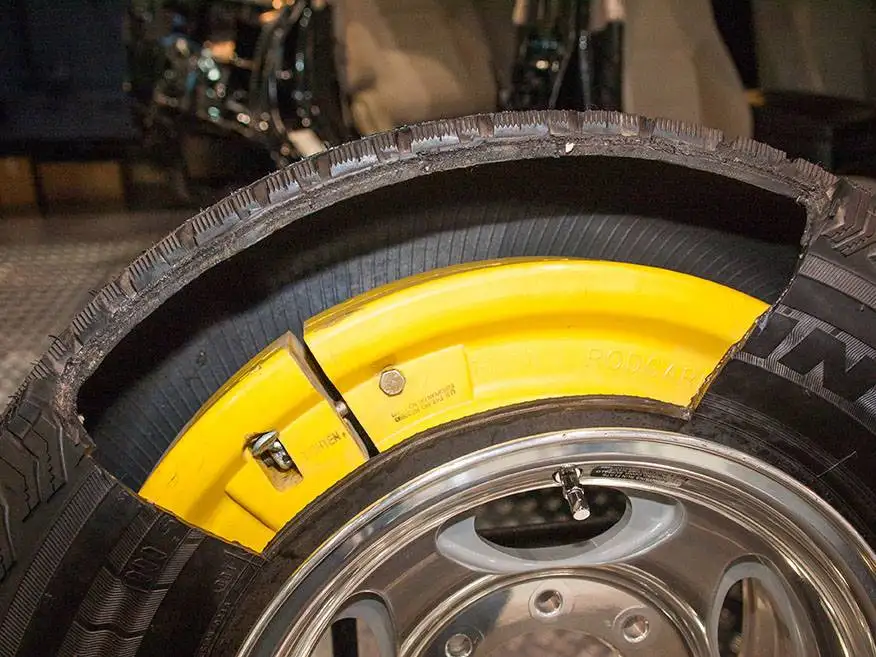
This is also the month people start pricing tires ahead of the changeover. So it's worth understanding what you're actually buying.
A run-flat gets you to a shop once. Then it gets replaced.
That's not a defect. It's how the tire is designed. But most owners find out at the counter rather than at purchase, and by then the decision has already been made for them.
Calgary is hard on tires in a specific way. The freeze-thaw cycle opens potholes faster than the road crews can close them, and by April there are edges out there sharp enough to take a sidewall. Add a summer of gravel on the highway out to Kananaskis and you get a few punctures a year through our doors that had nothing to do with the driver.
This is also the month people start pricing tires ahead of the changeover. So it's worth understanding what you're actually buying.
A run-flat gets you to a shop once. Then it gets replaced.
That's not a defect. It's how the tire is designed. But most owners find out at the counter rather than at purchase, and by then the decision has already been made for them.
Older cars had a well in the boot floor with a full-size spare sitting in it. Modern European cars mostly don't, and it isn't a cost cut. That space went to batteries, to larger fuel tanks, to sound deadening and structure. Weight targets did the rest, because a spare and a jack is roughly 20 kilograms you're carrying every day for something you might use once.
Something had to cover the gap. That's the problem run-flats were built to solve.
A run-flat has a reinforced sidewall stiff enough to hold the car's weight with no air in it at all. Puncture one and you keep driving, up to 100km which is enough to get off the highway and into a shop.
Worth knowing: you often can't feel it happen. The tire doesn't go soft in the steering, because the sidewall is doing the job the air pressure used to do. Your TPMS warning is the only thing telling you anything is wrong, which is why ignoring that light is a more expensive decision on a run-flat than on a conventional tire.
We don't repair run-flats that have been driven on while deflated, and neither do the tire manufacturers who make them.
Here's the mechanism. During that drive home, the sidewall is carrying load it was never meant to carry continuously, and it heats and flexes in a way that can damage the internal structure. None of that is visible from the outside. A tire that looks perfectly fine on the rack can be compromised, and there's no reliable way to inspect for it. So a single nail in the tread, the kind of puncture we'd plug and patch on a conventional tire for a fraction of the cost, becomes a new tire.
On an German car it can become more than one, since those systems want the tread depths matched across an axle or across the car. So if your other tire is around half life, you are looking at 2 brand new ones.
We'll be fair about the trade. Run-flats do something real: if a tire lets go suddenly at highway speed, that stiff sidewall keeps the car settled and predictable while you slow down. That's worth something.
But you pay for it every day. Run-flats ride harder over expansion joints and broken pavement, they cost more up front, and every puncture is a replacement instead of a repair. For most of the driving people actually do here, commuting, weekend trips, the occasional run west, the daily penalty outweighs the once-in-a-decade benefit.
So we recommend conventional tires, and then we solve the stranding problem separately.
We sell an inflation kit that lives in the trunk and takes up almost no space. It's a 12-volt compressor that runs off the car, plus a sealant that goes in through the valve and forms a temporary seal from the inside. Same idea as a run-flat: get you to a shop under your own power. The difference is that at the end of it you're buying a repair, not a tire.
Be clear about what it can and can't do. It handles small punctures in the tread. It does nothing for a sidewall cut, a damaged valve, or a tire that's come off the bead. In those cases you're calling for a tow either way, and so is the person on run-flats.
A lot of modern convenience features work like this. The car gets simpler and lighter, and a cost moves quietly onto the owner. That's fine when you know about it going in. It's frustrating when you find out at the counter.
If you're buying tires this season and you're not sure which way to go, bring the car by. We'll look at what's on it now, tell you what your specific car needs, and lay out what each option costs over a set of tires rather than over one purchase. Our door is open whenever you want that conversation.
When you come to Sheni’s Auto Trend, you join our family. Sign up for our newsletter for information about upcoming events, performance upgrade inspiration, and tips on keeping your car in tip top shape directly in your inbox.
At Sheni’s, your comfort and safety are our number one priority.